IU-led Alzheimer's drug discovery center moves forward with promising new therapeutic targets
Research team leverages multidisciplinary expertise to speed translation of scientific discoveries to patients
INDIANAPOLIS — Indiana University School of Medicine researchers have identified a portfolio of novel drug targets that may accelerate promising treatments for patients living with Alzheimer’s disease.
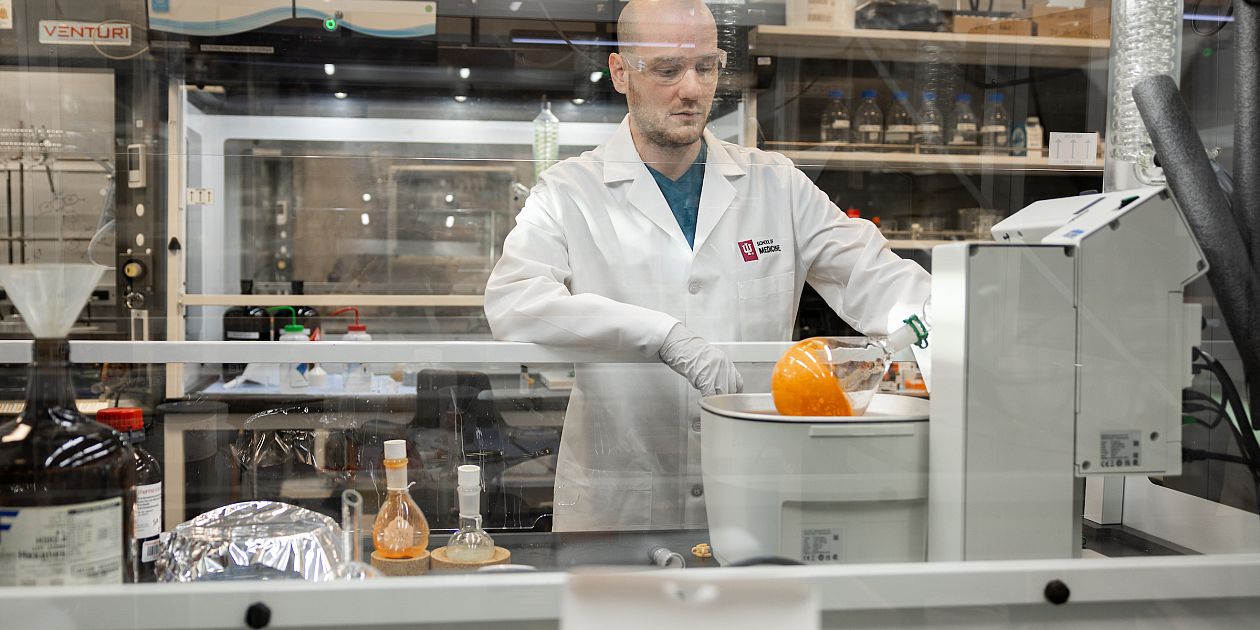
A researcher works in a chemistry lab at the Indiana Biosciences Research Institute (IBRI). The institute is a key partner in the IU-led TREAT-AD center. Photo by Liz Kaye, Indiana University
For more than half a decade, the IU-led TREAT-AD drug discovery center — Target Enablement to Accelerate Therapy Development for Alzheimer’s Disease — has spearheaded this integral research to reinvigorate and grow the pipeline of potential therapeutics for Alzheimer’s disease. The center is a partnership between researchers at the IU School of Medicine, Purdue University, the Indiana Biosciences Research Institute, Lgenia Inc. and the University of Pittsburgh.
"What has been collectively accomplished across the IU School of Medicine over the past several years has begun to solidify a true center of excellence that investigates the basic science of Alzheimer’s disease, translates it to therapeutic opportunities and develops a pathway for next-generation clinical studies,"
Building a portfolio of promising targets
Palkowitz leads the drug discovery center with co-principal investigators IU Distinguished Professor Bruce T. Lamb, and Timothy Richardson, senior research professor of medicine at the IU School of Medicine.
In December 2024, the National Institute on Aging awarded TREAT-AD a five-year, $41.6 million grant renewal. Established in 2019, TREAT-AD initially focused on hundreds of proteins related to the function of microglia — the brain’s immune cells — that may contribute to and protect against Alzheimer’s disease. The team narrowed down a list of hundreds of potential targets to 30 and then focused on building a portfolio of five that are particularly promising as potential new therapies.
Focusing on SHIP1 and Next-Generation Clinical Studies
The most advanced target is SHIP1, encoded by INPP5D, a microglia-specific gene that has been associated with late-onset Alzheimer’s disease. Building on the foundational work of TREAT-AD to enable the development of a program targeting SHIP1, the IU School of Medicine also received a five-year, $11.3 million grant to advance a SHIP1 inhibitor into potential clinical trials.
Over the next five years, TREAT-AD will look beyond the brain’s immune system and broaden its scope into investigating additional drivers of neuroinflammation in the brain and how it connects to later stages of Alzheimer’s disease.
Read the full press release at IU News: IU-led Alzheimer’s drug discovery center moves forward with promising new therapeutic targets